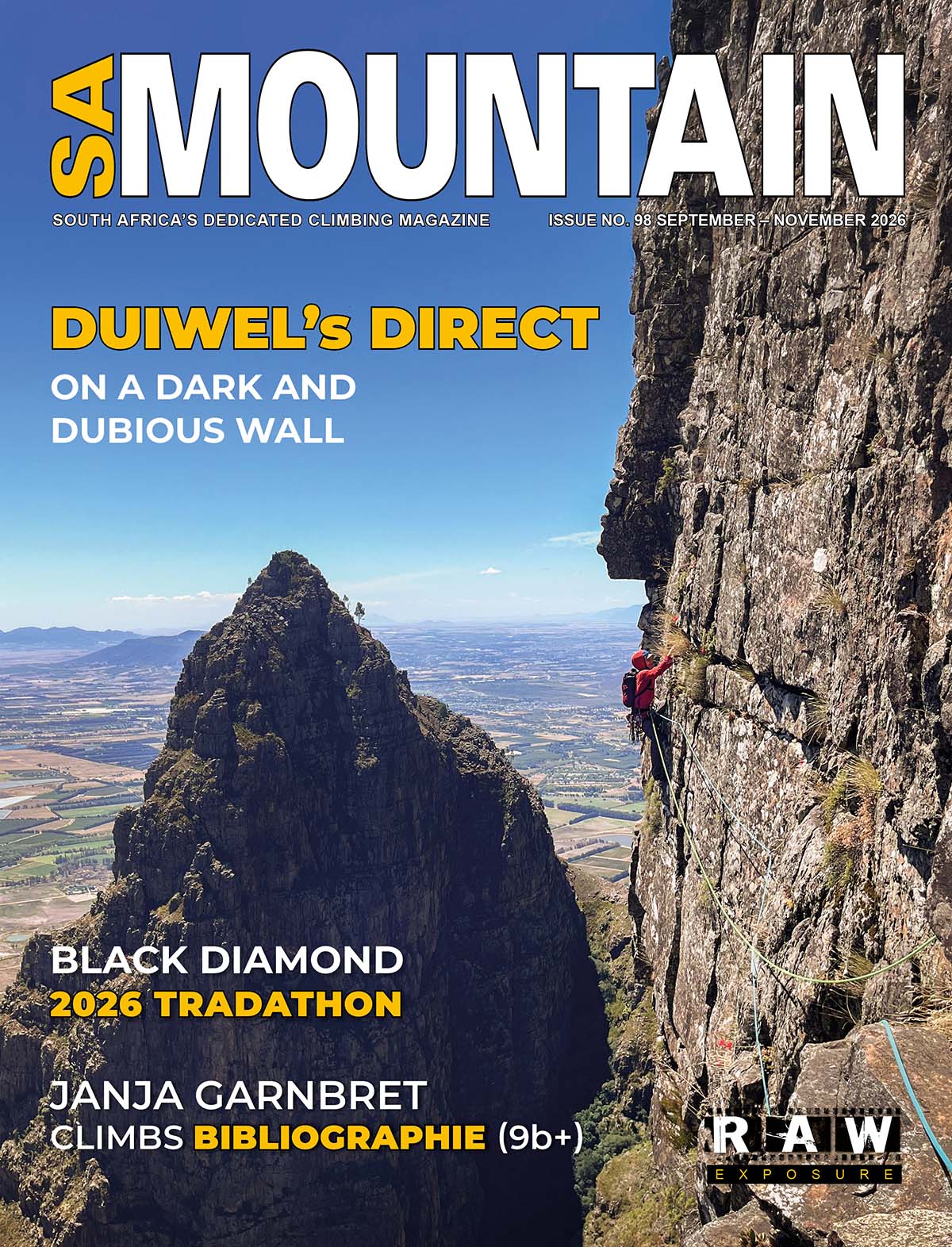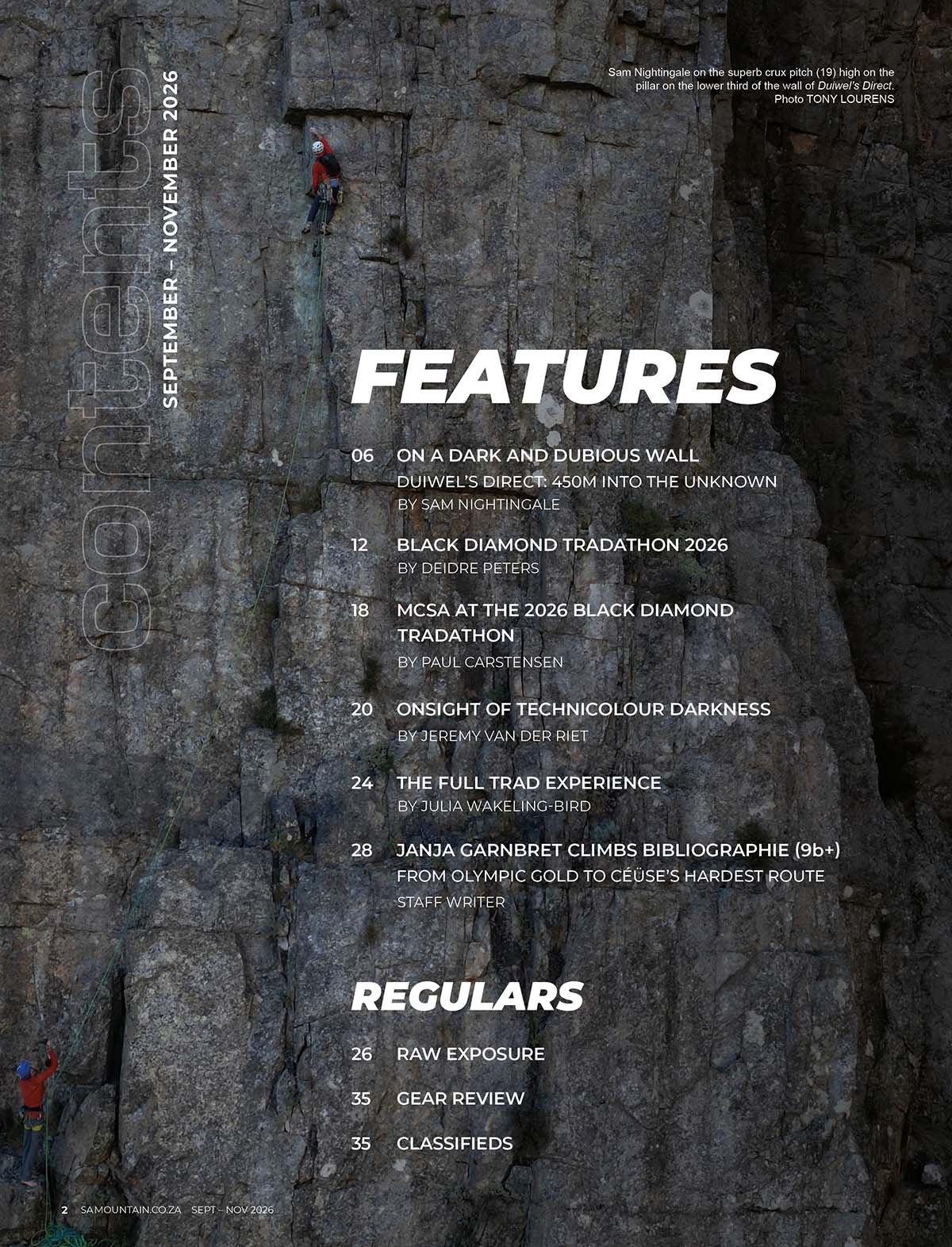
Read the editorial and explore the latest issue—packed with fresh news coverage, expert training advice, in-depth gear reviews, celebrity features, hands-on technical tips, event reports, and stunning photography, all wrapped up in captivating articles.
Editorial
The right to risk
When Snake Dike on Half Dome in Yosemite Valley got retro-bolted a few months back, social media exploded with all sorts of keyboard battles. Lots of people for, and lots against the bolting. Some put forward reasonable arguments, others ludicrous, and everything in between.
The furore actually started quite a few years ago when Anna Parsons, from New Zealand, took a long and nasty fall on the route, severely injuring herself. Many people were outraged that a ‘popular’ route could be so perilous and pose such grave danger to anyone wanting to climb it.
The only surviving first ascensionist of the route (which was opened in 1965), Eric Beck, was consulted and he said that he wouldn’t mind if a few extra bolts were added to make it safer. Then, earlier this year, Eric Sloan went up and popped in 16 extra bolts, which, to most pukka climbers, was unacceptable. This started the whole commotion again. Keyboard warriors came out in full force.
I would just like to put my opinion across: First of all, non-climbers (of which there were many commenting on social media, judging by the comments) have absolutely no licence or authority, in any shape or form, to weigh in on this. It is like me commenting on a thread relating to crossing the Atlantic solo in a canoe – I know f-kall about it!
Let me start off by saying that the ‘game’ of climbing is a very personal experience. It is a powerful emotional journey that is part physical, part psychological, very spiritual and deeply passionate. Everyone is on their own journey, and climbing does not have the same power over every individual the same way.
Climbing, by definition, draws on physical and mental strengths, the amounts of which vary, depending on how far you are pushing the boat out on a particular route. This of course is different for all of us. And how we deal with the psychological demands of a particular route is very much a personal experience, depending on lots of variables. But this is the aspect of climbing that is the most important factor which makes climbing what it is. If we removed the fear or potential danger from climbing, the game we know and love would instantly cease to be.
I’m sure I speak for most climbers (particularly trad climbers) when I say that the preparation – mental and physical – leading up to a demanding and often scary lead, is a space that is owned by you alone. Only you can work your way through it. And then comes the process of actually keeping all those variables in check and piecing together the moves, the gear and holding that necessary feeling of fear at bay. Total concentration. Nothing else in the universe enters your bubble. During that short period, you are on the most important journey of your life. Then the top-out, and that indescribable feeling of euphoria. Slumped on the rope after clipping the chains, that huge cauldron of emotion all comes rushing through. Some shout at the top of their voice, some break down in tears and others just sit in silence, often in disbelief at what they have just pulled off.
What I am trying to say is that every climber has the right to choose where they want to place themselves in the risk arena. Their experience and mind control should dictate to them what routes they are capable of climbing or working towards climbing. And they alone decide that.
If a route is too scary, or too run out for you, then move on and find a route that suits your abilities – there are many. Routes with a ‘reputation’ need to be there. They are there for climbers to aspire to and this is what makes climbing what it is.
The Bachar/Yerian route on Medlicote Dome in Tuolumne was opened in 1981, it is graded 5.11c R/X. This equates to about grade 24 with a high risk of very long falls, potentially resulting in serious injury or worse. This route has a serious reputation and hard climbers, climbing way above its grade, take this route very seriously and train especially, to make an ascent of this classic. No one would dream or in fact dare to add extra bolts to make it ‘safer’. The route is what it is. Climb it if you have the cojones, or walk away and find a route that suits you. Simple as that.
Be safe in the hills
Tony