by MATTHEW HOLT
An Ascent of Peak Lenin
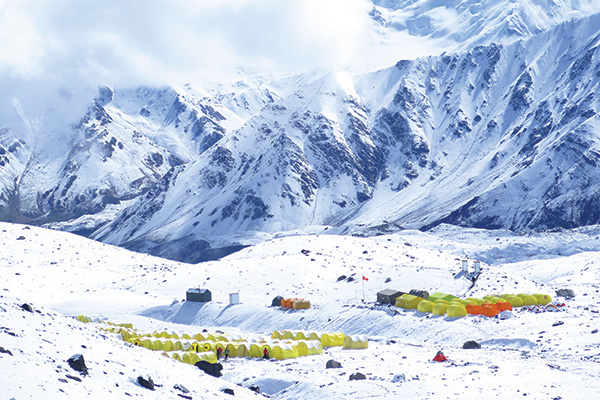
As the alarm trilled 2 am, I sat up, snagged my head on the tent ceiling and sent a shower of frozen condensation down my neck. With our tent seemingly designed for a lone dwarf, Mandy and I took turns to wriggle into salopettes, harnesses, double boots and down jackets. By the time we’d forced down some breakfast, nearly two hours had passed. Crawling outside, we found our seven teammates struggling into crampons, though they were impossible to identify under hoods, buffs and dazzling headlamps. Shouldering packs, gathering ice axes and poles, we set off. No matter how many expeditions you’ve done, there’s still a flutter in your gut when you head out on summit day.
For some, the ‘stans’ conjure up the romance of the Silk Road. For mountaineers, they’re the habitat of Snow Leopards: not the furry cuddly sort, but a quintet of peaks over 7,000 metres. In the Soviet era, you got a medal and were called a Snow Leopard if you managed all five. Peak Communism is the highest, at 7,495 metres; Pobeda is the hardest, with a fatality rate to rival K2; and Peak Lenin is, by all accounts, the easiest – making it my obvious choice. (When first climbed by a German trio in 1928, at 7,134 metres, it was the highest peak ascended by man.)
If the opening of the Iron Curtain had facilitated access, I still endured long transits in Istanbul and Bishkek, before finally landing in Osh. Kyrgyzstan’s oldest city claims to pre-date Rome, though there were few signs of antiquity amongst the Communist-era concrete blocks. At sunset, I climbed a prominent outcrop called Solomon’s Throne, but even soft golden light couldn’t make Osh attractive. I also visited the bazaar to buy a ‘kalpak’; the pointy, white felt hat worn by Kyrgyz men with panache. I just looked comical. However, local custom decrees you shouldn’t kill someone wearing a kalpak, which I hoped Peak Lenin might respect.
Subscribe to get your hard copy or read online