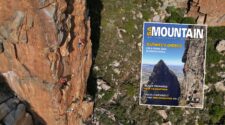
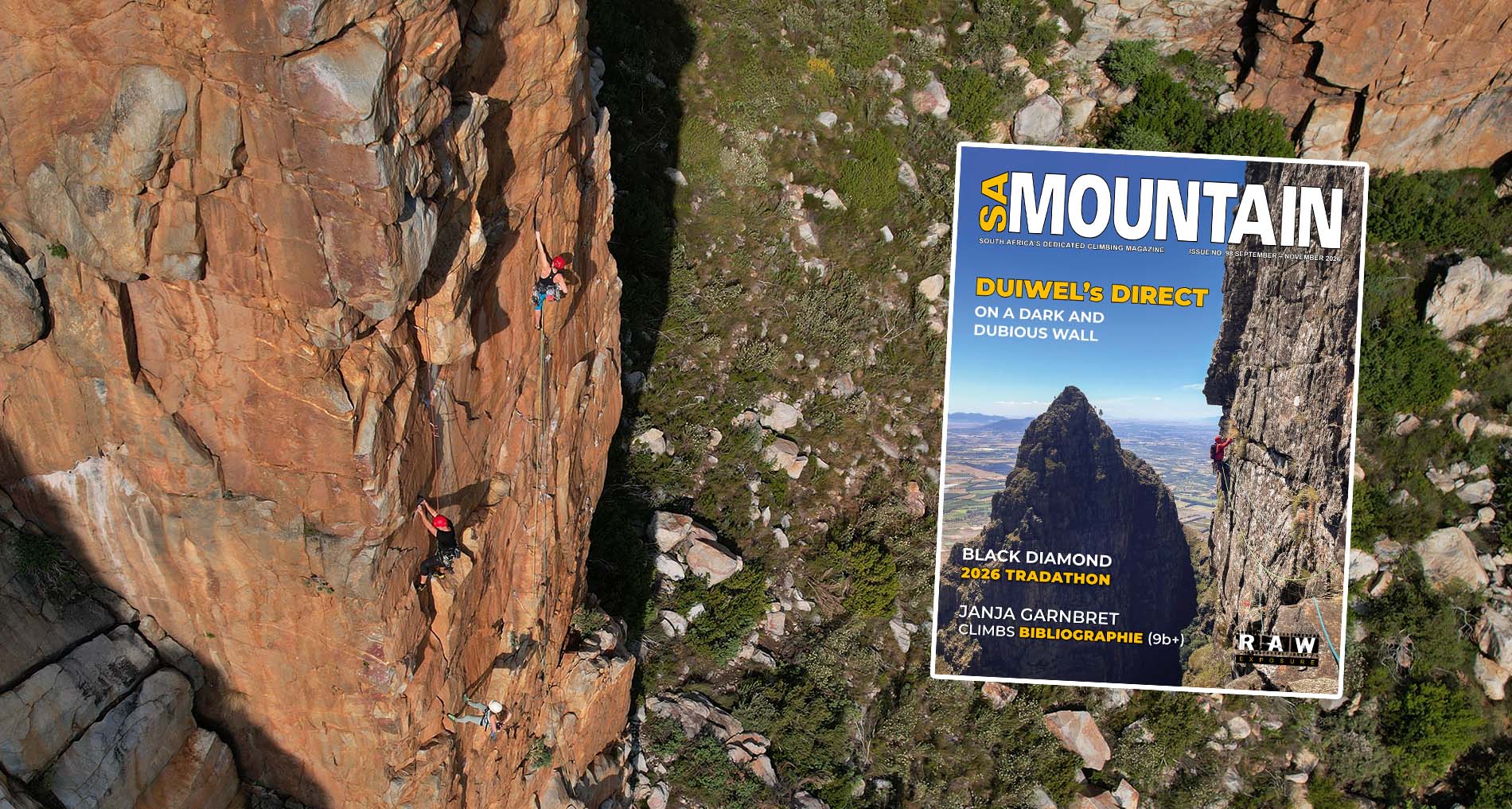
Read the editorial and check out the contents of the latest issue.
With up-to-date news coverage, training articles, gear reviews, celebrity profiles, technical tips covering a wide variety of subjects, event reports, big glossy pics and enthralling articles.
Editorial
Does climbing ever leave us?
This is an editorial I wrote 10 years ago. After reading it, I realised how relevant it still is today and how passionate I still am about climbing 50 years later.
My friend Paul and I had our first introduction to mountain scrambling with the ‘mountain club’ at Wynberg Boys’ High School. We both quite enjoyed it, so, like most young teenagers (we were 13 at the time), we threw caution to the wind and decided to pursue this new-found love with vigour.
Our parents, seemingly oblivious of what we were really getting ourselves into, allowed us to venture into the hills on our own. Armed with the old MCSA Table Mountain Guidebook, we started doing easy classic scrambles on the mountain and we would do these with huge overnight packs and then sleep out on top of Table Mountain, and watch the city lights at night. Sometimes we would even arrive at the top cable station and knock on the door. In those days, the cableway operation was driven from the top and there was always someone up there. They would welcome us in and let us sleep in some of the bunk beds. It was a rather unique and special time in our lives.
Then one day, walking down along Fountain Ledge, I saw climbers chimneying up the first pitch of a route called Companion Way, using rope and all the gear. I stood there in awe, and it was then that I decided that we needed to try this rock-climbing thing, so we tentatively went to the MCSA clubhouse one Friday evening, got signed in (oh, things were very different those days) and put our names down for a rock meet with ‘The Club’ which eventually saw us pulling into Sunnycove railway station and looking up at the fearsome cliffs of Elsie’s Peak. Rock meets in the ’70s were quite grand affairs, with high attendances. Paul and I were split into two separate parties and I did a route called Amphitheatre Wall, which I found quite daunting, but later discovered that it was one of the easiest routes on the buttress. After this, our confidence had been boosted somewhat, so we decided that we were going to go up to Africa Ledge and climb that fearsome face beneath the top cable station called Arrow Final, which unbeknown to us was often used as a descent by some of the ‘hard-core’ climbers by simply down-soloing it.
Anyway, armed with a rope, some slings, a handful of steel carabiners and a picture of the Arrow Final face we had torn out of a cableway brochure, we walked up the India-Venster trail to the foot of the route. I was terrified, and I said to Paul that he was leading the route. At the base, we uncoiled our rope and Paul slung our slings around his neck and was about to set off up the first pitch, when two climbers in their early twenties appeared and asked us what we were up to. ‘We’re going to climb Arrow Final,’ we said proudly. They looked at our pitiful lack of gear, glanced at each other, then proceeded to correct our shoddy belay anchor and explain some belay practices and general rules on how to stay alive while climbing. After they left, Paul and I, with a little bit more knowledge than a minute before, slowly made our way up that ‘smooth, exposed’ face. We took about four hours to climb the 80-metre route, as we made very short pitches, because we felt safer if we did not get too far apart. At the top we were so elated that we ran to the call box outside the cable station and phoned our mothers to tell them of our amazing achievement.
A few weeks later, we marched into the MCSA Friday night meet. I mean, we were proper climbers now and deserved to be there. Alas, we couldn’t find anybody to sign us in and were just about to be thrown out on our respective ears, when we saw the two climbers that came to our rescue on Arrow Final. They gladly signed us in and introduced us to the legendary Mike Scott and some other climbers. Our two saviours were none other than Kevin Weir and Duncan McLachlan, a strong duo who in the ’70s opened some impressive routes on the Cape Peninsula. Duncan also went on to film Chris Lomax in the now famous video – Solo Climber.
They later told us that when they saw us that day, we looked so ill-prepared, under-equipped and scared, that they were convinced we were going to kill ourselves if they did not come to our aid. This is the camaraderie and mutual passion that bonds climbers in a universal brother/sisterhood. One in which we lay our lives in the hands of our rope mates.
Today, five decades later, I have seen numerous beginners taking their first tentative steps into the ‘fearful’ but glorious world of rock climbing. A world that knows no boundaries to passion, and one that makes us powerless to resist the call of the vertical world.
Whether you are 13 and just discovering your new love, or 70 and have lived a long and full love story, climbing has a way of holding your soul in a firm but gentle grip, keeping that fire burning year after year.
That is the lure of the hills. That is what makes it so special.
Be safe in the hills
Tony
Features
Honeymooning in Ama Dablam
by Julia Wakeling Bird
The Moai
Sacred site southeast Tasmania
by David Barnes
The Black Diamond Tradathon 2023
by Garvin Jacobs
Regulars
RAW Exposure
Gear Reviews
Classic Climb: Last Moon
by Paul Fatti
Classifieds
Book Review
Off the Wall
Climbing injuries and rehab: Shoulder injuries
by Brenda Marx