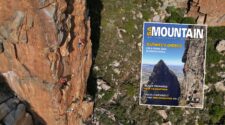
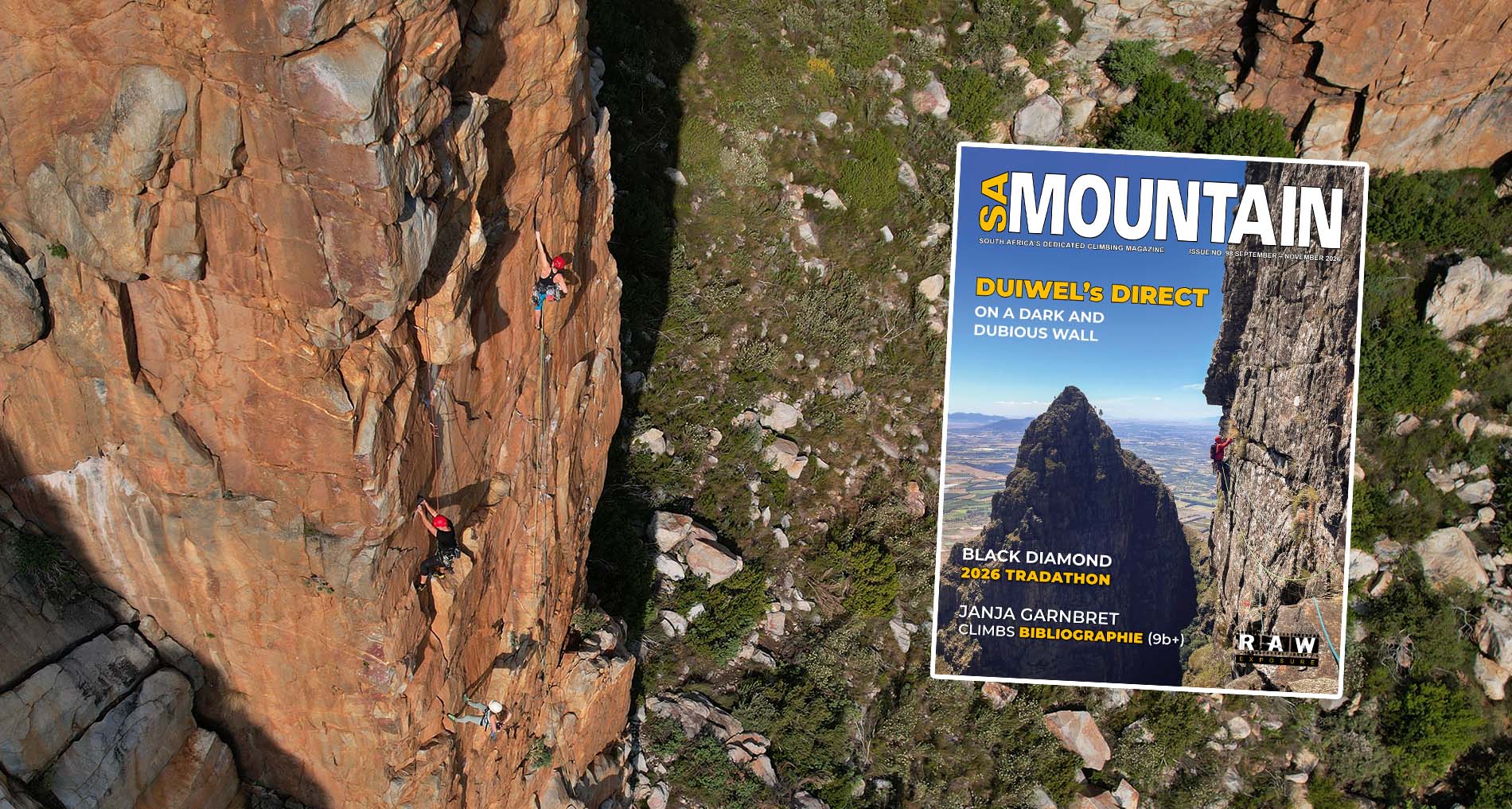
Read the editorial and explore the latest issue—packed with fresh news coverage, expert training advice, in-depth gear reviews, celebrity features, hands-on technical tips, event reports, and stunning photography, all wrapped up in captivating articles.
Editorial
Alone and ropeless – calculated feat or sheer madness?
Every now and then free-solo climbing is brought to the fore either by sensationalism in the form of some outrageous solo done by Alex Honnold (or other climbers), or indeed by the sad news of the death of a solo climber. This time around it is unfortunately the latter. Grant Cline, a young, super keen climber, who recently got a job in Yosemite, and was a fairly regular solo climber of relatively low-grade routes – up to 5.8 (± 16/17 in SA grades) lost his life on 6 June, falling from one of Yosemite’s classic routes, Royal Arches. He was only 18 years of age.
Gavin Feek, journalist for Outside Magazine, wrote a beautiful, heart filled article on Grant’s tragic accident. The last paragraph jumped out at me: “Free soloing will continue. But I’m not sure that it’s fair to simply write all free soloists off as reckless. It’s their lives, after all. And if you love someone, you’re supposed to love everything about them. Those who connect to Yosemite are hardwired to enjoy the freedom of movement, purity, and rhythm that free soloing its formations allows.”
Read Gavin’s full article here: https://www.climbing.com/community/yosemite-free-soloist-who-fell-from-royal-arches-grant-cline.
Ever since that palm-sweating movie Free Solo, which features Alex Honnold soloing Free Rider on El Capitan, graced our screens some time back, the audacious, risk-taking of this particular form of rock climbing was brought with terrifying clarity into the homes of millions of people around the planet. Almost without exception, non-climbers (and many climbers) are quick to label this form of climbing as madness, reckless, irresponsible, having a death wish . . . the list goes on.
But what drives a person to walk the thin edge between life and death? To risk all for a brief, momentary victory where one mistake would almost certainly mean the end of the line. Non-climbers and even 99 percent of climbers would never dream of climbing high up on a rock wall without the safety back-up of rope and protection gear.
With roped climbing, it is quite incredible the shift of concentration and sharpness in focus a climber has from following a rock climb with the rope above, compared to leading, when the rope is now below and the climber is totally responsible for their own safety and ultimately their own life or death. Everything becomes clearer and crisper. The mind is sharper, quicker, more calculating. Eyes darting around, taking in all and retaining only what is necessary – sequences, gear placements, rest opportunities, rope management. Now remove the rope and that focus and concentration takes a quantum leap into another dimension. A dimension incomprehensible to the layperson. Movements are clean and deliberate; the mind blocking out all outside influences.
The solo climber is not some lunatic who has decided to play Russian Roulette at the turn of a card. No. He or she is an athlete at the very cutting edge of the sport. An athlete that, with superior mind control, pushes the limit of physical and particularly mental endurance.
Soloing demands unwavering mental discipline. There is no room for second thoughts or a change of heart. Perched on a bulging rock wall 200 vertical metres above the talus slopes, feet on tiny smears and fingertips of one hand supporting your body weight, commitment is total. Any form of doubt is firmly locked out.
How does the soloist know what’s ahead? What if they can’t negotiate a certain section? What happens if they get tired and can’t hold on anymore? These are all questions that are asked a thousand times. The soloist does not just pull a climb out the bag and then trot off to climb it. On the contrary. It is almost always a climb that is known to them, sometimes intimately. It is a climb that has great appeal. It is a carefully calculated game that cannot allow for errors.
But, while the rewards are great, no practice is less forgiving. Of course climbers get killed soloing, but then so do extreme solo yachtsmen, racing drivers, Arctic explorers, base jumpers and a number of other players who live on the edge. These are the people who have chosen to push the boundaries of the seemingly impossible, the adventurers who rewrite the record books. The world needs these people, so we can be reminded of what the human race is capable of; so we can sit and watch mind-blowing movies and read enthralling articles about the ‘mad buggers’ out there who are not happy to merely do what others have done before.
We all have to die sometime. It’s just that some would prefer their chances on a rock wall (or other extreme situation) rather than behind a corporate desk fraught with long stressful hours.
To put things into perspective, statistically, the chances of being killed on a huge snow and rock wall in the Himalaya (or the Alps for that matter) with ropes and all the paraphernalia, is far greater than soloing a clean rock route that is known to the climber. We are all more or less the same in body, but it’s the spirit that makes all the difference.
As Ernest Hemingway once wrote, ‘It takes more cajones to be a sportsman when death is a closer party to the game.’
Be safe in the hills
Tony
Features
The Kyrgyzstan Affair – sends and bails in the Karavshin Valley
by Richard Halsey
Mossel Bay – SA’s best sea-cliff climbing
by Dëon van Zyl
The Black Diamaond Tradathon 2025 – Monteseel
by Brad Inggs
Regulars
RAW Exposure
Gear Reviews
Classifieds
Classic Tale – The Illearth Stone
by Andy de Klerk